Health Savings Accounts (HSAs) are among the most valuable financial tools available to Americans, yet they’re also among the most misunderstood. Many people think HSAs are only useful for paying current medical bills, that the money must be spent each year, or that you need an employer to open one.
These misconceptions can prevent people from taking advantage of an account that offers an unusual combination of tax savings, investment opportunities, and long-term financial flexibility.
Unlike ordinary savings accounts, an HSA can provide three federal tax benefits: tax-deductible or pre-tax contributions, tax-free investment earnings, and tax-free withdrawals for qualified medical expenses. That makes it useful for handling today’s health care bills while also preparing for potentially substantial medical expenses in retirement.
And those future expenses shouldn’t be underestimated. According to Fidelity’s 2026 Retiree Health Care Cost Estimate, a 65-year-old retiring in 2026 may need approximately $185,500 in after-tax savings to cover health care costs throughout retirement.
Understanding how an HSA works could make a meaningful difference to your financial future. Let’s examine eight common HSA myths and explain what the rules actually mean for your money.
Myth 1: I’m Too Old to Open or Contribute to an HSA
The reality: HSA eligibility depends primarily on your health insurance coverage and Medicare enrollment, not your age.
There’s no maximum age for opening or contributing to an HSA. If you have an HSA-eligible health plan, aren’t enrolled in Medicare, and meet the other eligibility requirements, you can generally contribute regardless of whether you’re 30, 50, or 67.
In fact, people approaching retirement receive an additional advantage. Once you reach age 55, you can contribute an extra $1,000 annually as an HSA catch-up contribution.
For 2026, the standard HSA contribution limits are:
| Coverage Type | 2026 Limit | Age 55+ |
|---|---|---|
| Self-only coverage | $4,400 | $5,400 |
| Family coverage | $8,750 | $9,750 |
Note: The catch-up contribution is per eligible individual. Married spouses aged 55 or older must each use their own HSA for their respective catch-up contributions.
Enrolling in Medicare generally ends your eligibility to make new HSA contributions, including during certain periods of retroactive Medicare coverage. However, it doesn’t affect ownership of the money you’ve already saved.
You can continue using your HSA for qualified medical expenses throughout retirement, including eligible Medicare premiums, deductibles, prescriptions, and certain long-term care expenses.
There’s another important benefit after age 65: HSA withdrawals for nonmedical purposes are no longer subject to the additional 20% federal tax. You’ll still owe ordinary income tax on those withdrawals, but this gives the account flexibility similar to a traditional IRA.
What this means for you: Even if retirement is only a few years away, contributing to an HSA may still be worthwhile. And if you’re already retired, your existing HSA can remain a valuable source of tax-advantaged funds.
Myth 2: HSA-Eligible Health Insurance Plans Are Always Too Expensive
The reality: Higher deductibles don’t necessarily mean higher total health care costs.
One of the biggest concerns about HSA-eligible plans is that they often require you to pay more out of pocket before insurance begins covering certain expenses.
That’s a legitimate consideration, but the deductible tells only part of the story.
Many HSA-eligible high-deductible health plans (HDHPs) come with lower monthly premiums than traditional insurance plans. For individuals and families who don’t require frequent medical treatment, those premium savings can be substantial.
Consider a hypothetical comparison:
| Annual Costs | HSA-Eligible Plan | Traditional Plan |
|---|---|---|
| Monthly premium | $350 | $500 |
| Annual premiums | $4,200 | $6,000 |
| Annual out-of-pocket medical costs | $1,800 | $900 |
| Employer HSA contribution | $750 | $0 |
| Net annual cost | $5,250 | $6,900 |
Illustrative example only. Actual premiums, deductibles, employer contributions, and medical expenses vary by plan.
In this example, the HSA-eligible plan costs $1,650 less over the year, even though the individual pays more directly for medical services.
Employer HSA contributions can improve the equation further. Some companies deposit money into employees’ HSAs, effectively helping fund future medical expenses.
Even without an employer contribution, HSA tax benefits can make the overall arrangement attractive.
However, an HSA-eligible plan isn’t automatically the best choice for everyone. Someone with significant ongoing medical needs may find a traditional plan more suitable, depending on premiums, provider networks, deductibles, and maximum out-of-pocket expenses.
It’s also important to recognize that not every insurance plan with a high deductible qualifies for HSA contributions. The plan must satisfy applicable federal eligibility requirements.
What this means for you: Compare the total annual costs of different health plans rather than focusing exclusively on deductibles or monthly premiums. Include potential employer HSA contributions and tax savings in the calculation.
Myth 3: Medicare Will Cover All My Medical Expenses in Retirement
The reality: Medicare provides important coverage, but retirees still face considerable health care costs.
Many Americans assume that once they turn 65 and qualify for Medicare, their financial concerns about medical bills will largely disappear.
Unfortunately, retirement health care is rarely that simple.
Medicare beneficiaries may still need to pay for:
- Medicare premiums, deductibles, copayments, and coinsurance.
- Prescription drugs and medications not fully covered by insurance.
- Dental treatments, eye exams, glasses, and hearing aids.
- Long-term care services, including certain nursing home and home care expenses.
The numbers can add up quickly.
According to Fidelity’s 2026 Retiree Health Care Cost Estimate, a 65-year-old retiring in 2026 may need approximately $185,500 in after-tax savings to cover health care expenses throughout retirement.
Fidelity’s estimate assumes specified Medicare coverage and includes certain premiums and out-of-pocket medical expenses. It does not include every possible retirement health cost, such as most dental care and long-term care.
This is where an HSA can become especially useful.
Qualified medical expenses can be paid directly from your HSA without federal income tax. Eligible costs may include Medicare Parts B and D premiums, out-of-pocket medical bills, dental care, vision services, and qualified long-term care expenses.
Certain insurance premiums are eligible, but not all. For example, Medicare supplemental insurance premiums, commonly known as Medigap premiums, generally cannot be paid tax-free from an HSA. Qualified long-term care insurance premiums are subject to age-based limits.
If you’ve built a substantial HSA balance during your working years, the account can help absorb retirement health care expenses without requiring you to withdraw additional taxable money from traditional retirement accounts.
And after age 65, the option to make penalty-free, taxable withdrawals for nonmedical purposes adds another layer of financial flexibility.
What this means for you: Medicare should be part of your retirement health care strategy, not your entire strategy. An HSA can help fill the financial gaps Medicare leaves behind.
Myth 4: You Can Only Open an HSA Through Your Employer
The reality: Anyone who meets the eligibility requirements can open an HSA independently.
Many people first encounter HSAs through workplace benefits packages, so it’s understandable that they associate these accounts with employer-sponsored programs.
But you don’t need an employer to open one.
If you qualify, you can establish an HSA through a bank, credit union, brokerage firm, or other financial institution offering HSA services.
This is particularly helpful for self-employed professionals, freelancers, small business owners, and individuals whose employers don’t provide an HSA.
For example, someone who purchases an HSA-eligible health insurance plan independently may still open an HSA at a financial institution such as Fidelity.
Another significant benefit is portability.
Unlike some workplace benefit accounts, your HSA belongs to you personally. Changing jobs doesn’t mean losing the account. Neither does switching insurance providers or retiring.
Even if you eventually move to a health plan that no longer qualifies for HSA contributions, you can retain the existing balance and use it for eligible expenses.
You simply cannot make new contributions during periods when you don’t meet the eligibility requirements.
What this means for you: Your employer doesn’t control whether you can own an HSA. As long as you meet the eligibility rules, you can select a provider that offers suitable investments, competitive fees, and convenient account management.
Myth 5: You Must Spend Your HSA Balance Before the End of the Year
The reality: HSA funds roll over automatically, year after year, without expiration.
This misconception often arises because people confuse HSAs with Flexible Spending Accounts (FSAs).
Although both accounts provide tax advantages for eligible medical expenses, they operate differently.
Many traditional health FSAs are subject to use-it-or-lose-it rules. Employers may offer permitted carryovers or grace periods, but unused funds can otherwise be forfeited.
HSAs have no equivalent annual spending deadline.
Here’s how the accounts generally compare:
| Feature | HSA | Health FSA |
|---|---|---|
| Unused funds carry forward | Yes, indefinitely | Limited by plan rules |
| Account owned by individual | Yes | Generally employer-sponsored |
| Investment opportunities | Often available | Generally unavailable |
| Funds retained after leaving job | Yes | Generally subject to plan and continuation rules |
| Intended for long-term savings | Yes | Primarily short-term expenses |
With an HSA, every unused dollar remains yours.
Suppose you contribute $3,000 to your HSA this year but spend only $500 on eligible medical expenses. The remaining $2,500 stays in the account and carries into the following year.
If you continue contributing and invest part of your balance, your HSA may grow into a meaningful long-term asset.
For someone with manageable current medical expenses, allowing the account to accumulate over many years can be a practical retirement planning strategy.
There are no required minimum distributions during your lifetime, and you don’t have to begin spending the money at a particular age.
What this means for you: You don’t need to rush to use your HSA at year-end. Preserving unused funds can help you prepare for larger medical expenses later in life.
Myth 6: You’re Only Allowed to Have One HSA
The reality: You can own multiple HSAs and choose how to manage them.
There’s no rule limiting you to a single HSA.
You might have an account established through a previous employer, another offered by your current workplace, and a third opened independently through an investment provider.
All of them can remain open.
For instance, suppose your employer deposits money into an HSA managed by a specific benefits administrator. You might want to keep that account to receive the employer’s contributions while maintaining a separate HSA with Fidelity for its investment options.
That’s generally permitted.
The important limitation is that your annual HSA contribution limit applies across all your HSAs combined, not separately to each account.
If your 2026 contribution limit is $4,400 and your employer contributes $1,000, you generally have only $3,400 of remaining contribution room across your accounts, assuming full-year eligibility and no catch-up contribution.
Having multiple HSAs can provide additional choices, but it may also complicate recordkeeping and increase account maintenance fees.
That’s why consolidating accounts may be useful.
You can generally move HSA funds between providers through a direct trustee-to-trustee transfer without triggering income taxes. Properly executed direct transfers aren’t subject to the once-per-12-month restriction that applies to certain indirect HSA rollovers.
Another advantage is that you can open an HSA at any time during the year. You’re not required to wait for your employer’s annual benefits enrollment period, although your contribution eligibility still depends on your qualifying coverage and other circumstances.
What this means for you: Multiple HSAs are allowed, but maintaining a smaller number of well-managed accounts may simplify your finances and reduce unnecessary costs.
Myth 7: Money in an HSA Cannot Be Invested
The reality: Many HSA providers allow account holders to invest their balances in stocks, ETFs, mutual funds, and other investments.
This is one of the most important HSA benefits people overlook.
An HSA isn’t necessarily just a place to hold cash for doctor visits and prescriptions. Depending on your provider, it can also function as a long-term investment account.
Some providers offer access to diversified mutual funds, exchange-traded funds (ETFs), and individual securities.
For example, Fidelity allows eligible HSA customers to begin investing with as little as $1, without requiring a minimum cash balance.
That makes investing accessible even for people who are just starting to accumulate health care savings.
The long-term potential becomes clear when you consider the effect of compounding.
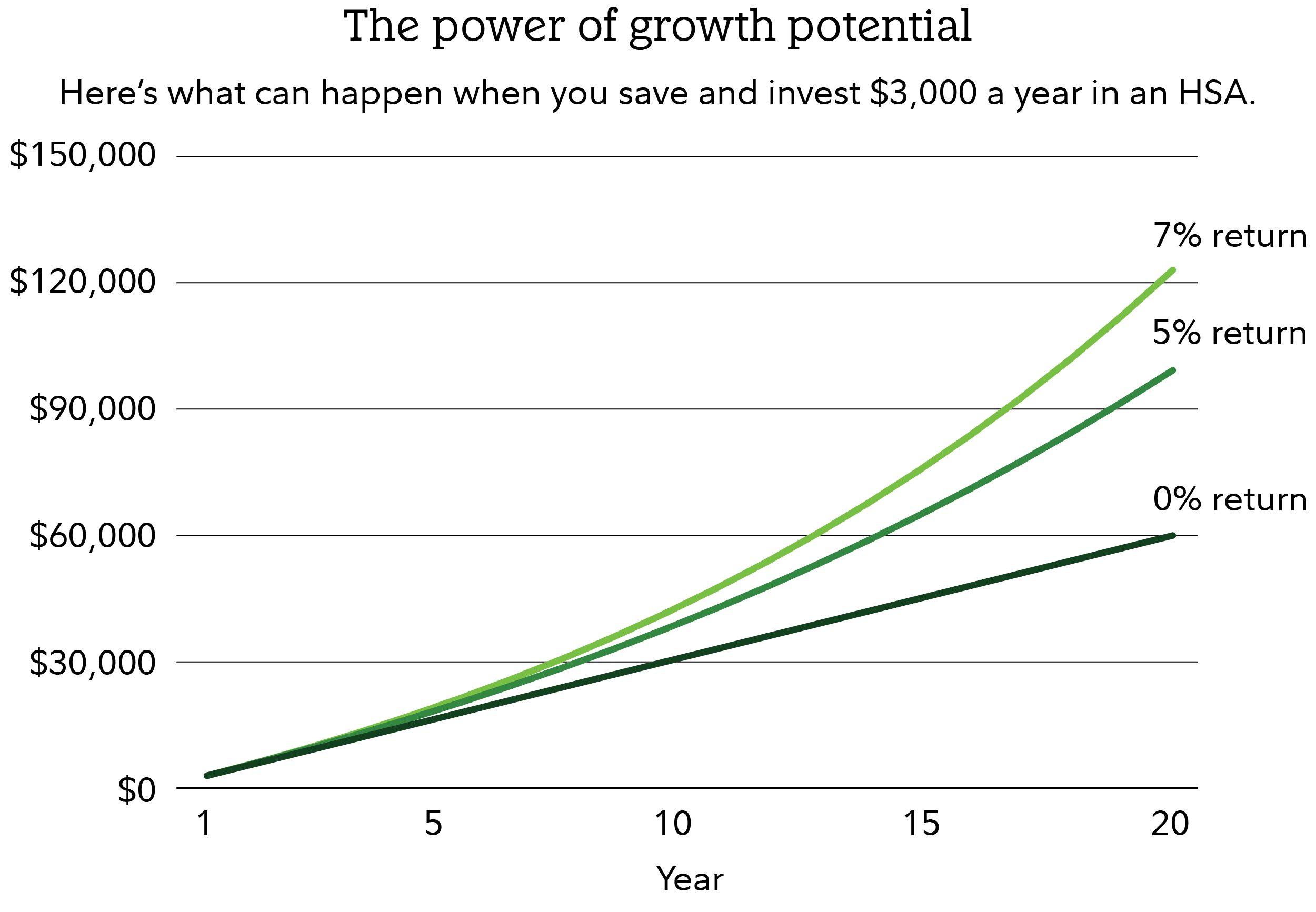
Suppose you invest $3,000 annually in your HSA for 20 years and earn an average annual return of 7%.
| Investment Period | Estimated HSA Balance |
|---|---|
| 5 years | $17,252 |
| 10 years | $41,449 |
| 15 years | $75,387 |
| 20 years | $122,986 |
| Total contributions | $60,000 |
| Potential investment earnings | Approximately $62,986 |
Illustrative calculations assume $3,000 contributed at the end of each year, a 7% annual return, and no withdrawals or fees. Returns are not guaranteed.
After two decades, the account could grow to approximately $123,000, more than twice the amount contributed.
And if those funds are eventually withdrawn for qualified medical expenses, the investment earnings can generally be used free of federal income tax.
Of course, investments can lose value, and a 7% return is hypothetical rather than guaranteed. Money needed for near-term medical bills may be better kept in cash or other lower-risk holdings.
A reasonable strategy is to estimate how much you expect to spend on health care during the next year, maintain enough liquidity for those expenses, and consider investing the remaining balance based on your financial goals and risk tolerance.
There’s another valuable feature worth understanding: delayed reimbursement.
If you pay eligible medical expenses using personal funds instead of your HSA, you may reimburse yourself from the HSA years later, provided the expenses were incurred after the HSA was established, were not reimbursed elsewhere, and were not claimed as a tax deduction.
Current federal rules impose no general deadline for taking such reimbursements. However, maintaining accurate receipts and records is essential.
This approach can allow invested HSA money to remain in the account longer, although it should only be considered if your household can comfortably cover medical bills without using HSA funds immediately.
What this means for you: Treat your HSA as more than an emergency medical fund. With appropriate investment choices and a long-term perspective, it can become a significant tax-advantaged asset.
Myth 8: An HSA Isn’t a Retirement Account, So It Can’t Help With Retirement
The reality: Although HSAs were created for medical expenses, they can play a valuable role in retirement planning.
Technically, an HSA isn’t a traditional retirement account like a 401(k), Traditional IRA, or Roth IRA.
But that distinction doesn’t prevent it from being a powerful retirement savings tool.
In fact, when used for qualified medical expenses, an HSA combines tax advantages that are difficult to find in other account types.
A traditional 401(k) generally provides tax-deferred contributions and investment growth, but withdrawals are usually subject to ordinary income tax.
A Roth IRA uses after-tax contributions but can provide tax-free investment growth and qualified withdrawals.
An HSA can provide the benefits of both approaches for eligible medical spending.
| Tax Feature | Traditional 401(k) | Roth IRA | HSA |
|---|---|---|---|
| Tax-deductible or pre-tax contributions | Generally yes | No | Generally yes |
| Tax-deferred or tax-free investment growth | Yes | Yes | Yes |
| Tax-free qualified medical withdrawals | Generally no | Qualified distributions are tax-free | Yes |
| Tax-free qualified retirement withdrawals for any purpose | No | Yes | No |
| Required minimum distributions during owner’s lifetime | Generally yes | No | No |
This comparison helps explain why some financial planners consider an HSA an important complement to conventional retirement accounts.
For example, a retiree might use HSA money for medical expenses while preserving other investments for everyday living costs.
Because qualified HSA distributions are generally excluded from federal taxable income, they can also reduce the need for taxable retirement account withdrawals.
After age 65, the ability to make nonmedical withdrawals without the additional 20% penalty makes the account more flexible still, although ordinary income tax remains due on those distributions.
It’s important to remember that the HSA isn’t a replacement for retirement accounts. Contribution limits are relatively modest, and the account’s greatest tax advantage depends on spending the money on qualified medical expenses.
But used alongside a 401(k), IRA, or Roth IRA, an HSA can help diversify the tax treatment of retirement savings and provide funds specifically earmarked for health care.
What this means for you: An HSA deserves a place in retirement planning conversations, particularly if you expect significant medical costs later in life.
How to Make the Most of Your HSA in 2026
Now that the most common misconceptions are out of the way, the next question is how to use an HSA effectively.
The right approach depends on your income, medical needs, insurance coverage, age, and investment time horizon. Still, several habits can help you maximize its potential.
First, confirm that you’re eligible to contribute. Enrollment in an HSA-qualified health plan is essential, but other coverage can affect eligibility. For example, being covered by certain traditional health FSAs, non-HDHP insurance plans, or Medicare may disqualify you from making contributions.
Second, consider contributing consistently. Even relatively small recurring contributions can help build an account balance over time. If your employer offers HSA contributions, make sure you understand how to receive the full available benefit.
Third, select your provider carefully. Review investment options, expense ratios, administrative fees, cash requirements, and account functionality rather than assuming your employer’s default provider is your only choice.
Fourth, maintain records of medical spending. This is particularly important if you’re using the delayed reimbursement strategy. Receipts, explanations of benefits, and payment records may be necessary if you ever need to substantiate a tax-free HSA distribution.
Finally, review your investment allocation periodically. An HSA intended to cover a major medical expense next year should generally be managed differently from one intended to remain invested for the next 20 years.
One additional tax consideration deserves attention: HSA contributions and qualified distributions receive favorable federal treatment, but state tax rules can differ. California and New Jersey, for example, do not fully follow federal HSA tax treatment, so state income taxes on contributions and investment earnings may apply.
Final Thoughts: Don’t Let HSA Myths Cost You Valuable Tax Savings
Health Savings Accounts are far more versatile than many Americans realize.
They aren’t reserved for young workers, they aren’t limited to employer-sponsored programs, and their balances don’t expire at the end of the year. You can maintain multiple accounts, invest your savings, and continue using accumulated funds well into retirement.
Most importantly, HSAs offer a rare combination of current tax savings, long-term investment potential, and tax-free withdrawals for qualified medical expenses.
With retirement health care costs continuing to rise, that flexibility has become increasingly valuable.
Whether you’re self-employed, working for a company that offers HSA benefits, or approaching retirement, understanding the rules can help you make more informed decisions about health insurance, taxes, and long-term savings.
An HSA may not be the right account for everyone, but for eligible individuals who use it strategically, it can be much more than a way to pay medical bills. It can become an important part of a broader financial plan designed to protect both your health and your retirement savings.
Disclaimer: This article is provided for educational and informational purposes only and does not constitute personalized investment, tax, or legal advice. HSA eligibility, contribution limits, qualified expenses, and state tax treatment depend on individual circumstances. Consult a qualified tax or financial professional before making decisions about your HSA.
Author:Com21.com,This article is an original creation by Com21.com. If you wish to repost or share, please include an attribution to the source and provide a link to the original article.Post Link:https://www.com21.com/8-common-hsa-myths-debunked.html