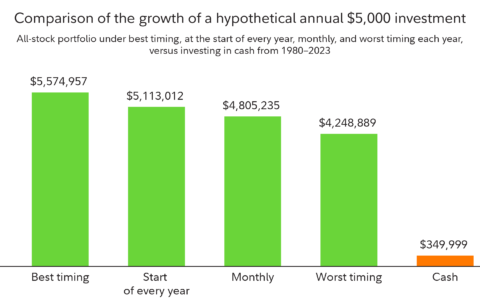
As 2026 enters its final quarter, investors face a familiar challenge: How can they continue building wealth while protecting their portfolios from uncertainty and keeping more of their investment returns?
The answer isn’t necessarily to chase the hottest stocks or search for the highest yields. Sometimes, the smartest investment opportunities come from combining dependable income, long-term growth potential, downside protection, and intelligent tax planning.
Taxes are one of the most overlooked expenses in investing. A portfolio might generate impressive returns on paper, but what ultimately matters is how much money remains after taxes, fees, and inflation. For investors in higher tax brackets, particularly those living in high-tax states, the difference can be substantial.
Fortunately, several investments offer opportunities to improve after-tax returns without taking unnecessary risks. From municipal bonds and U.S. Treasurys to dividend-paying stocks and professionally managed portfolios, there are practical ways to position your money for the remainder of 2026 and beyond.
Here are five investment ideas worth considering right now, along with strategies that could make your portfolio more tax-efficient.
1. Municipal Bonds: Tax-Free Income With Defensive Appeal
Municipal bonds, commonly called “munis,” deserve attention from investors seeking relatively predictable income while minimizing their federal income tax burden.
These bonds are issued by state and local governments, municipalities, and certain public agencies to finance infrastructure projects, schools, transportation systems, and other public services.
Their biggest attraction is their favorable tax treatment.
Interest earned on most qualifying municipal bonds is exempt from federal income taxes. In many cases, investors who purchase bonds issued within their home state may also avoid state and local income taxes on that interest.
This combination can be particularly valuable for investors in states with relatively high income tax rates, such as California and New York.
Why municipal bonds are attractive in 2026
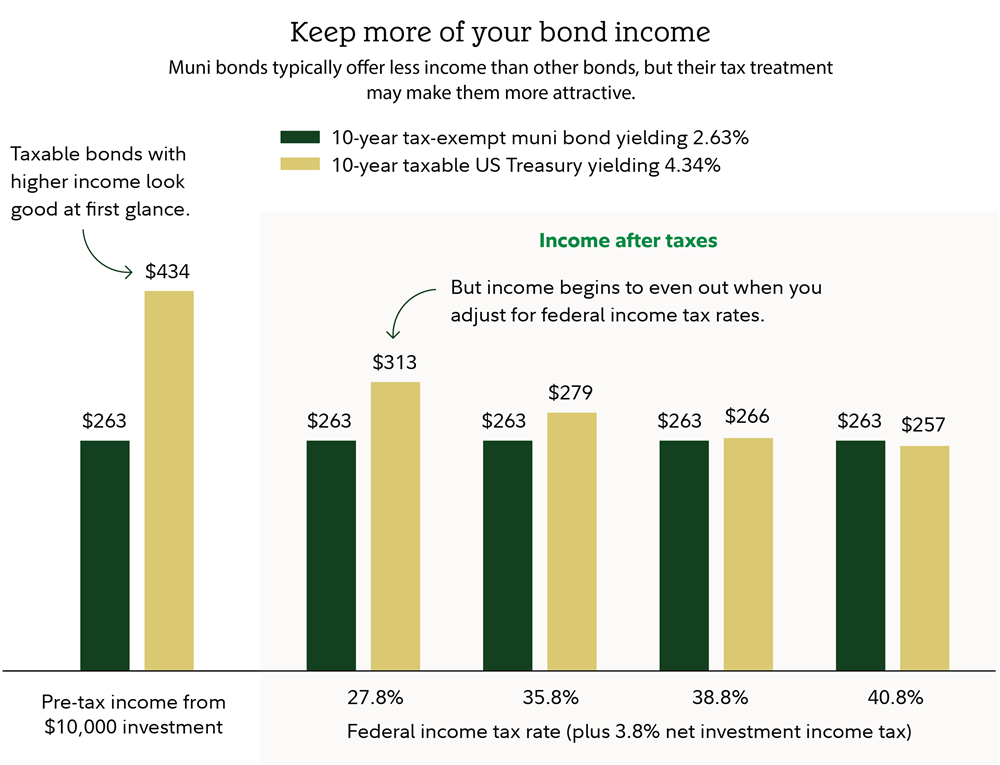
Municipal bonds often offer lower stated yields than comparable taxable bonds. However, comparing their yields without considering taxes can be misleading.
Consider an investor in the 35% federal marginal income tax bracket who purchases a municipal bond yielding 3.5%.
Assuming the interest is federally tax-exempt and ignoring additional taxes, the bond’s taxable-equivalent yield would be approximately 5.38%.
In other words, a taxable bond would need to yield roughly 5.38% to provide the same after-federal-tax income.
That difference illustrates why municipal bonds can be competitive even when their headline yields appear modest.
Municipal bonds may also help stabilize a diversified portfolio. High-quality issuers can provide a relatively dependable source of income, while different maturities allow investors to manage their exposure to changes in interest rates.
There are several ways to invest:
- Individual municipal bonds: Allow investors to choose specific issuers, maturities, and income schedules.
- Municipal bond mutual funds: Offer diversification across numerous bonds.
- Municipal bond ETFs: Provide diversified exposure with the convenience of exchange-traded securities.
- Separately managed municipal bond accounts: Offer professional management and customization based on income and tax objectives.
Fidelity, for example, offers municipal bond strategies such as its Intermediate Municipal Strategy and Limited Duration Municipal Strategy.
What investors should watch
Municipal bonds are not risk-free. Issuers can experience financial difficulties, and bond prices may decline when interest rates rise. Some bonds can also be called before maturity.
Additionally, certain municipal bond income may be subject to the alternative minimum tax, while capital gains from selling bonds can still be taxable.
Best suited for: Higher-income investors, residents of high-tax states, and investors seeking tax-efficient fixed income in taxable brokerage accounts.
For the remainder of 2026, municipal bonds are worth considering as part of a defensive income strategy, particularly when their taxable-equivalent yields compare favorably with those of Treasury and corporate bonds.
2. U.S. Treasury Securities: Safety, Liquidity, and Reliable Income
When financial markets become unpredictable, U.S. Treasury securities remain one of the most important tools available to conservative investors.
Treasurys are backed by the full faith and credit of the U.S. government, making them among the lowest-credit-risk investments available.
They also provide a valuable tax advantage.
Interest income from U.S. Treasury securities is generally subject to federal income tax but exempt from state and local income taxes.
For investors living in states with high tax rates, this treatment can make Treasurys more attractive than bank deposits, certificates of deposit, or corporate bonds offering similar pretax yields.
Different Treasury investments serve different purposes
The Treasury market offers several types of securities, each designed for different time horizons and income requirements.
| Treasury security | Typical maturity | How investors receive income |
|---|---|---|
| Treasury bills (T-bills) | 4 to 52 weeks | Generally purchased at a discount, with face value paid at maturity |
| Cash management bills | Variable | Generally purchased at a discount and repaid at maturity |
| Treasury notes | 2, 3, 5, 7, or 10 years | Fixed interest paid every six months |
| Treasury bonds | 20 or 30 years | Fixed interest paid every six months |
| Treasury Inflation-Protected Securities (TIPS) | 5, 10, or 30 years | Semiannual interest, with principal adjusted for inflation |
| Floating Rate Notes (FRNs) | 2 years | Quarterly interest based on a floating rate tied to 13-week Treasury bill auctions |
One important detail: Treasury securities generally have a minimum purchase amount of $100 when purchased directly through TreasuryDirect, although some brokerage platforms have different minimum order requirements, particularly in the secondary market.
Why short-term Treasurys deserve consideration
Investors who want to preserve capital while earning income may find Treasury bills especially practical.
Their short maturities limit exposure to interest-rate fluctuations compared with longer-term bonds. Investors can also construct a Treasury ladder by purchasing securities that mature at different intervals.
For example, an investor could divide $40,000 among four Treasury bill positions with staggered maturity dates.
As each security matures, the investor can decide whether to reinvest the proceeds or use the cash for another purpose.
This strategy offers flexibility while reducing the need to predict the direction of interest rates.
Longer-term Treasury notes and bonds may appeal to investors who want to lock in a fixed coupon rate for several years. However, they also carry greater sensitivity to changing interest rates.
TIPS offer another defensive feature: Their principal adjusts with inflation, helping protect purchasing power over time. Investors should remember that inflation-related principal adjustments can create taxable income in a regular brokerage account before cash is received.
How to invest in Treasurys
Investors can purchase newly issued Treasury securities through government auctions using TreasuryDirect or participating brokerage firms, including Fidelity.
Previously issued Treasurys can also be purchased on the secondary market.
Treasury ETFs and mutual funds provide convenient alternatives, although unlike an individual bond held to maturity, these funds generally do not offer a fixed maturity date or guaranteed redemption amount.
Best suited for: Conservative investors, retirees, cash-management strategies, and investors prioritizing liquidity and capital preservation.
For the final quarter of 2026, Treasurys remain a compelling defensive allocation. Their value lies not only in their income potential but also in their ability to balance riskier investments elsewhere in a portfolio.
3. Taxable Bonds and CDs: Maximize Compounding Through Tax-Advantaged Accounts
Corporate bonds, taxable government bonds, and certificates of deposit can play an important role in an income-focused portfolio.
However, where investors hold these investments can be almost as important as which securities they purchase.
In a regular taxable brokerage account, interest from most corporate bonds and bank CDs is generally taxed as ordinary income.
For investors in higher income tax brackets, those annual taxes can significantly reduce the amount available for reinvestment.
This is where tax-advantaged accounts become particularly valuable.
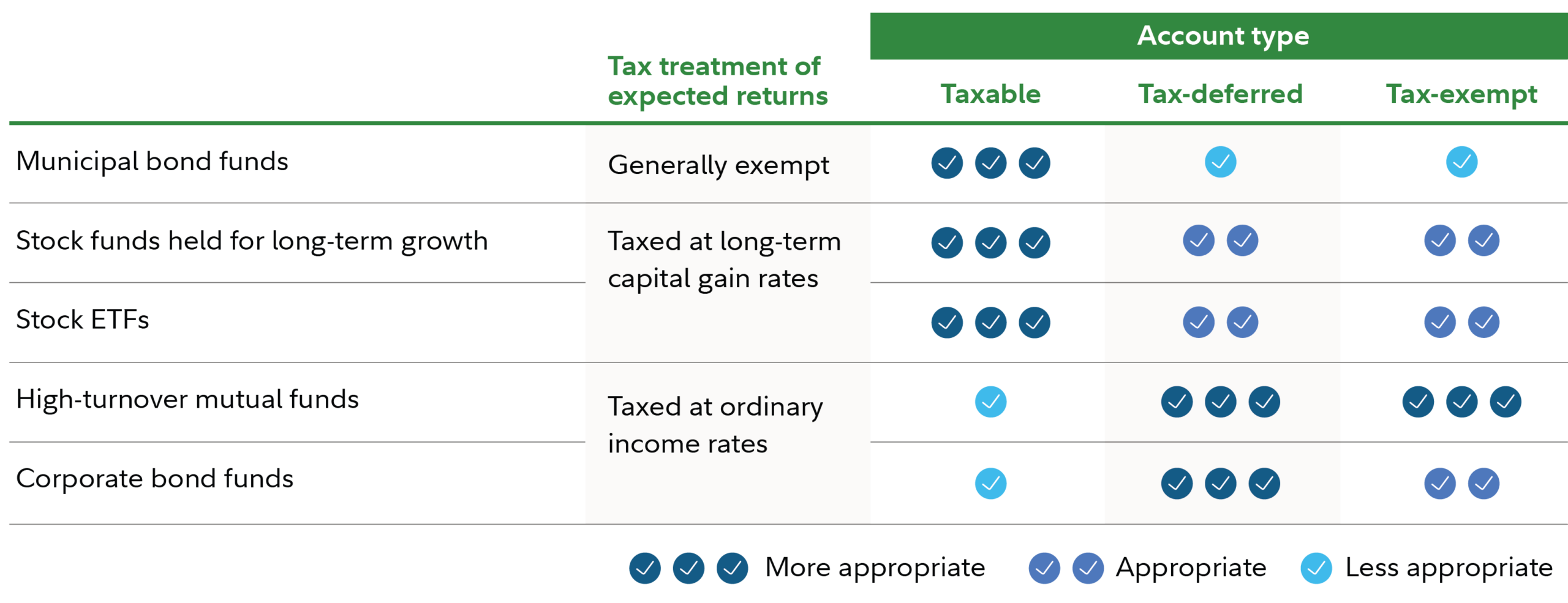
Why asset location matters
Asset location refers to deciding which investments to hold in taxable accounts versus tax-advantaged retirement accounts.
The concept is different from asset allocation, which determines how much of a portfolio is invested in stocks, bonds, cash, and other assets.
For example, an investor might choose to hold:
- Corporate bonds and CDs inside a traditional IRA or 401(k).
- Tax-efficient broad-market index funds inside a taxable brokerage account.
- Selected long-term growth investments inside a Roth IRA.
The idea is to place investments that regularly produce taxable income in accounts where those earnings can potentially compound without immediate taxation.
A traditional IRA generally defers taxes until withdrawals occur, while a Roth IRA may provide tax-free qualified withdrawals if applicable requirements are met.
The long-term impact of tax-efficient compounding
Consider a hypothetical $100,000 investment earning a consistent annual return of 5%, with all earnings reinvested.
If the investor pays a 30% tax on those earnings every year, the after-tax reinvestment rate would be approximately 3.5%.
After 20 years, the portfolio would grow to roughly $199,000.
If the same investment compounds at the full 5% annually without ongoing tax payments, its value would grow to approximately $265,000.
That represents a difference of about $66,000 before accounting for any eventual taxes on retirement-account withdrawals.
The example is simplified, but it illustrates how annual tax payments can reduce the power of compound growth.
Choosing the right fixed-income investments
Corporate bonds may offer higher yields than comparable Treasurys, but they also carry credit risk.
Certificates of deposit, meanwhile, can provide predictable interest payments and FDIC insurance when issued by insured institutions and held within applicable coverage limits.
For investors seeking greater stability, a ladder of CDs or high-quality bonds can reduce dependence on any single maturity date.
One consideration is that retirement accounts come with contribution rules, withdrawal restrictions, and potential penalties. Furthermore, holding tax-exempt municipal bonds inside an IRA generally offers little additional benefit because the account already provides tax advantages.
Best suited for: Long-term investors, retirement savers, and individuals who want to maximize the compounding potential of their fixed-income holdings.
The opportunity here is not simply earning more interest. It is ensuring that less of that interest is unnecessarily lost to annual taxes.
4. Qualified Dividend Stocks: Combine Long-Term Growth With Tax-Efficient Income
Dividend-paying stocks offer something that fixed-income investments generally cannot: the potential for both recurring cash distributions and long-term appreciation in the underlying business.
For investors who want income without completely sacrificing growth, high-quality dividend stocks can be an attractive middle ground.
But not all dividends receive the same tax treatment.
Understanding qualified dividends
Qualified dividends are generally taxed at the preferential federal rates applied to long-term capital gains.
For eligible investors, those federal rates are 0%, 15%, or 20%, depending on taxable income.
By comparison, ordinary dividends are generally taxed at ordinary income tax rates, which can reach 37% under the applicable federal tax structure. An additional 3.8% net investment income tax may also apply to certain higher-income taxpayers.
This difference can materially affect after-tax investment income.
Imagine receiving $10,000 in annual dividends.
If those dividends are taxed at a 15% qualified dividend rate, the federal tax would be $1,500, leaving $8,500.
If the same distributions were taxed as ordinary income at a 35% marginal rate, the federal tax would be $3,500, leaving just $6,500.
That is a $2,000 annual difference, before considering state taxes and any additional investment income tax.
Which dividends qualify?
To receive preferential tax treatment, dividends must satisfy specific requirements involving the paying corporation, the type of dividend, and the investor’s holding period.
For common stock, investors generally must hold the shares for more than 60 days during the 121-day period beginning 60 days before the ex-dividend date.
For certain preferred stock dividends covering periods longer than 366 days, the required holding period is more than 90 days during the corresponding 181-day period.
Eligible dividends generally come from U.S. corporations or qualifying foreign corporations, including certain companies whose American depositary receipts trade on established U.S. exchanges.
Distributions from real estate investment trusts (REITs) and master limited partnerships (MLPs) generally do not qualify for preferential dividend rates, although certain exceptions or separate tax benefits may apply.
Focus on dividend quality, not just yield
A common mistake among income investors is selecting stocks based solely on their dividend yields.
A stock offering a 9% dividend yield might appear more attractive than one yielding 3%, but an unusually high yield can sometimes reflect a falling share price or concerns about the company’s financial health.
Instead, investors should examine the fundamentals supporting the dividend.
Important factors include earnings consistency, free cash flow, balance-sheet strength, payout ratios, and management’s history of maintaining or increasing distributions.
Companies with sustainable dividends and opportunities for earnings growth may offer a better long-term combination of income and capital appreciation.
Dividend-focused mutual funds and ETFs can also provide diversification, although the tax treatment of distributions depends on the fund’s underlying investments and reported dividend classifications.
Best suited for: Long-term equity investors, income-oriented investors who can tolerate stock-market volatility, and individuals seeking a combination of dividend income and potential capital growth.
As 2026 approaches its conclusion, qualified dividend stocks may provide a way to pursue growth while retaining an important tax advantage in taxable accounts.
5. Tax-Managed Portfolios and Annuities: Advanced Solutions for After-Tax Returns
For investors with larger portfolios or more complex financial situations, selecting tax-efficient securities is only part of the equation.
The way investments are managed can also have a meaningful impact on after-tax returns.
Two strategies worth considering are separately managed accounts and tax-deferred annuities.
Although they serve different purposes, both can potentially help investors manage the timing and taxation of investment income.
Separately managed accounts: Professional tax management
A separately managed account, or SMA, is a professionally managed investment portfolio that generally holds securities directly on behalf of the investor.
Unlike a traditional mutual fund, an SMA can offer greater visibility into individual holdings and, depending on the manager and strategy, more flexibility over when taxable gains and losses are realized.
One of its most useful features is tax-loss harvesting.
Tax-loss harvesting involves selling investments that have declined in value to realize capital losses. Those losses can then potentially offset realized capital gains elsewhere in the portfolio.
Consider an investor who realizes $15,000 in capital gains during 2026 but also sells other investments at a combined $10,000 loss.
Assuming the losses are deductible and can be applied against those gains, the net taxable capital gain could be reduced to $5,000.
If an investor’s realized capital losses exceed realized capital gains, current federal tax rules generally allow up to $3,000 of the remaining net capital loss to offset ordinary income annually, or $1,500 for married taxpayers filing separately.
Unused capital losses can generally be carried forward to future tax years.
However, investors must follow the IRS wash-sale rules. Purchasing the same or substantially identical security within the restricted period around a loss sale can prevent the immediate deduction.
For investors who do not want to manage these transactions independently, a professionally managed SMA may provide a practical solution.
Fidelity offers traditional advisor-supported separately managed accounts as well as digitally managed investment solutions.
Investors should compare management fees, minimum investment requirements, portfolio customization, and the potential benefits of tax management before selecting a provider.
Tax-loss harvesting can improve after-tax results, but it does not eliminate market risk or guarantee permanent tax savings. It may simply defer certain taxes to a later date.
Tax-deferred annuities: Potential income for retirement
Tax-deferred annuities represent another option, particularly for higher-income investors who have already maximized contributions to their retirement accounts.
An annuity is a contract issued by an insurance company. Depending on the product, it may offer tax-deferred investment growth, future income payments, or certain contractual guarantees.
With a nonqualified tax-deferred variable annuity, investment earnings generally accumulate without current income taxation until withdrawals or annuity payments occur.
Investors may eventually convert the contract into a regular income stream or withdraw money according to the contract’s terms.
The important distinction is that tax-deferred does not mean tax-free.
Taxable earnings withdrawn from an annuity are generally taxed as ordinary income rather than at preferential long-term capital gains rates.
Withdrawals before age 59½ may also trigger an additional 10% federal tax on taxable earnings, unless an exception applies.
Variable annuities can involve investment risk, insurance charges, management fees, surrender periods, and other restrictions. Their value can fluctuate, and withdrawals or income payments depend on the specific contract.
For that reason, annuities are generally better considered after investors have evaluated more straightforward tax-advantaged options, including 401(k) plans and IRAs.
Best suited for: Higher-income investors, individuals with substantial taxable portfolios, and retirement-focused investors seeking professional tax management or potential long-term income solutions.
These strategies are more complex than buying a Treasury bill or dividend stock, but they can play a valuable role when aligned with an investor’s financial goals and tax situation.
Which Investment Makes the Most Sense for the Rest of 2026?
There is no single investment that will be ideal for everyone.
An investor approaching retirement may prioritize reliable income and capital preservation, while someone with decades until retirement may prefer dividend-growing businesses and tax-efficient equity exposure.
The following comparison highlights where each strategy may fit.
| Investment strategy | Primary objective | Main tax advantage | Key consideration |
|---|---|---|---|
| Municipal bonds | Tax-efficient income | Generally federal tax-exempt interest | Credit and interest-rate risk |
| U.S. Treasurys | Capital preservation and income | State and local income tax exemption | Inflation and interest-rate risk |
| Taxable bonds and CDs in retirement accounts | Income and compounding | Tax-deferred or potentially tax-free growth | Account restrictions and credit risk |
| Qualified dividend stocks | Income and long-term growth | Preferential federal dividend tax rates | Stock-market volatility |
| Tax-managed portfolios and annuities | After-tax optimization and retirement planning | Loss harvesting or tax deferral | Fees, complexity, and withdrawal rules |
A diversified portfolio may incorporate several of these investments rather than relying exclusively on one approach.
For example, municipal bonds may provide tax-efficient income in a taxable account, Treasurys may supply stability and liquidity, and qualified dividend stocks may offer exposure to long-term corporate earnings growth.
Meanwhile, retirement accounts can shelter income-producing investments from annual taxation, and professionally managed strategies may help control the realization of capital gains.
The objective is to make different investments work together rather than compete for the same role.
Three Practical Moves Investors Can Make Before 2026 Ends
With the end of the calendar year approaching, investors have an opportunity to review not only what they own, but also how efficiently their portfolios are structured.
First, evaluate your after-tax investment yields. A taxable bond with a higher stated yield may not deliver more spendable income than a municipal bond or Treasury security once taxes are considered. Comparing after-tax returns can reveal opportunities that headline yields overlook.
Second, review investment placement across accounts. Examine whether taxable bonds, CDs, and other income-producing assets would be more efficient inside retirement accounts. At the same time, consider whether broad-market index funds and qualified dividend-paying investments are appropriate for taxable accounts.
Third, review realized gains and losses before December 31. Investors who have accumulated capital gains may benefit from evaluating potential tax-loss harvesting opportunities. This process should be guided by the overall investment strategy rather than taxes alone, with careful attention to wash-sale rules and transaction costs.
Importantly, these changes should not require abandoning a carefully constructed long-term portfolio. Tax planning works best when it supports investment discipline rather than dictating every trading decision.
Final Thoughts: Keep More of What Your Investments Earn
Successful investing is not simply about finding the asset with the highest potential return. It is about building a portfolio capable of generating wealth while managing risk, preserving flexibility, and minimizing unnecessary costs.
For the remainder of 2026, five investment areas deserve serious consideration: municipal bonds, U.S. Treasurys, taxable bonds and CDs held in tax-advantaged accounts, qualified dividend stocks, and advanced tax-managed investment solutions.
Each brings something different to the table.
Municipal bonds offer opportunities for tax-exempt income. Treasurys provide defensive strength and favorable state tax treatment. Tax-advantaged accounts can make fixed-income compounding more efficient. Qualified dividend stocks combine income with potential appreciation, while separately managed accounts and tax-deferred annuities may serve investors with more sophisticated planning needs.
Ultimately, the most effective investment strategy is one built around your financial goals, tax bracket, risk tolerance, and investment horizon.
The key lesson for investors is simple: What you keep after taxes matters just as much as what you earn before them.
As the final months of 2026 unfold, reviewing your portfolio through that lens could be one of the most worthwhile financial decisions you make.
Disclaimer: This article is for educational and informational purposes only and does not constitute personalized investment, legal, or tax advice. Investment returns are not guaranteed, and all investments involve risk. Tax treatment depends on individual circumstances and applicable laws. Consult a qualified financial advisor or tax professional before making significant investment decisions.
Author:Com21.com,This article is an original creation by Com21.com. If you wish to repost or share, please include an attribution to the source and provide a link to the original article.Post Link:https://www.com21.com/5-investments-with-real-potential-right-now-smart-ideas-for-growth-defense-and-tax-efficient-income-through-the-end-of-2026.html