The U.S. stock market has delivered another strong year, but persistent inflation, higher interest rates, expensive valuations, artificial intelligence speculation, and geopolitical uncertainty could challenge the rally. Here are five major stock market risks investors should understand—and why there are still reasons to remain optimistic.
The U.S. stock market has enjoyed a remarkable run in 2026, overcoming economic uncertainty, geopolitical tensions, and changing expectations for interest rates. Yet beneath the impressive performance, several risks have emerged that could determine where stocks go next.
After gaining more than 12% earlier in the year, the S&P 500 has struggled to maintain its upward momentum in recent months. The benchmark index approached 8,000 points in early October before pulling back, closing near 7,580 on October 30. Even after the decline, the index remained up approximately 10.7% for the year.
For investors, this combination of strong returns and growing uncertainty presents a familiar dilemma: Is the bull market running out of steam, or is the recent volatility simply a healthy pause before the next advance?
There are legitimate reasons for caution. Inflation remains stubborn, borrowing costs are rising, stock valuations are elevated in parts of the market, and the artificial intelligence boom has raised concerns about excessive speculation. Global instability and declining consumer confidence have added further pressure.
However, the underlying economy has shown considerable resilience. Corporate earnings continue to grow, businesses are investing heavily in new technologies, and consumer spending has held up better than many analysts expected.
As 2026 enters its final two months, five stock market risks deserve particular attention.
1. Persistent Inflation and Rising Interest Rates
Inflation has been one of the most persistent economic challenges of recent years, and 2026 has offered little relief.
American households continue facing elevated prices for groceries, housing, energy, transportation, and other essential expenses. Businesses are dealing with many of the same pressures, including higher wages, raw material costs, and transportation expenses.
According to the U.S. Bureau of Labor Statistics, the Consumer Price Index (CPI) increased 3.7% year over year in September 2026, significantly above the Federal Reserve’s long-term inflation target of 2%.
Energy prices have been a particularly important driver of inflation. Ongoing international conflicts, trade tensions, and supply disruptions have contributed to higher fuel costs, making it difficult for inflation to return to more comfortable levels.
Meanwhile, the federal government’s fiscal position has introduced another complication.
The Congressional Budget Office estimated that the U.S. federal budget deficit reached approximately $2 trillion in fiscal 2026, reflecting substantial government spending and growing interest expenses.
Large deficits can put additional pressure on government borrowing needs and financial markets, potentially contributing to higher long-term interest rates.
Why higher interest rates threaten stocks
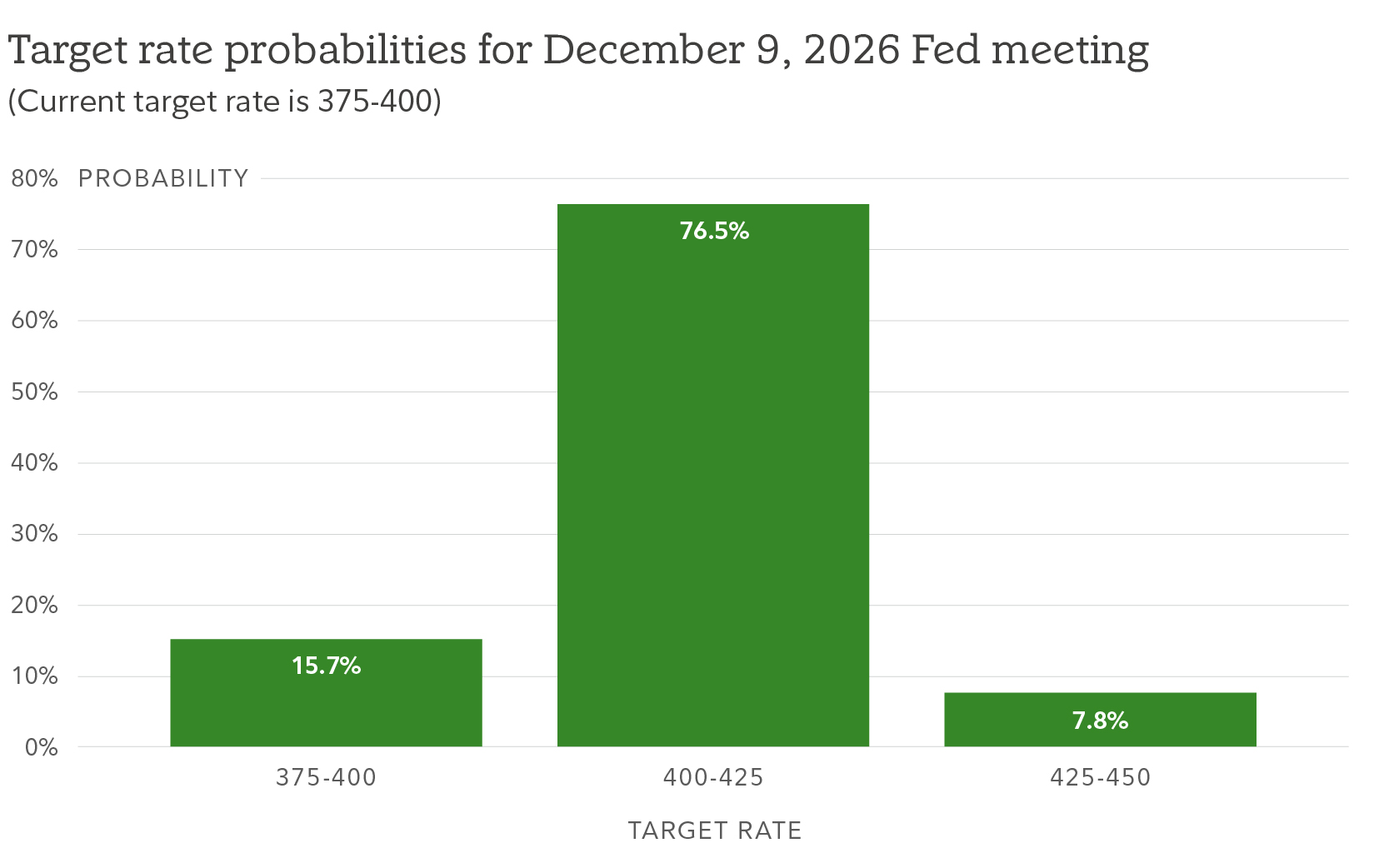
In September, the Federal Reserve raised its benchmark interest rate by 25 basis points to a range of 3.75% to 4.00%, marking its first rate increase in three years.
The central bank held rates steady at its October 28 meeting, but policymakers continued emphasizing that inflation remains elevated. Financial markets have also been pricing in the possibility of another increase before the end of 2026.
For investors who entered the year expecting lower interest rates, this shift has been disappointing.
Higher borrowing costs can affect stock prices in several ways.
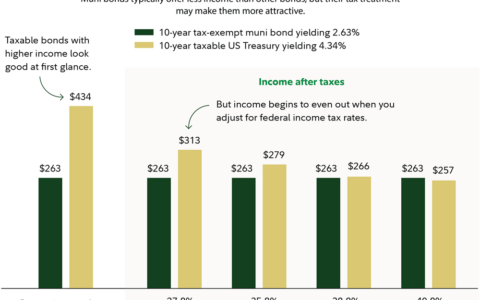
Businesses may face larger interest expenses when refinancing debt or funding expansion projects. Consumers may reduce spending as credit card rates, auto loans, and other financing costs remain elevated. At the same time, higher bond yields can make fixed-income investments more competitive with stocks.
Growth stocks can be especially sensitive to rising rates because much of their market value depends on earnings expected years into the future.
Why investors can still be optimistic
Despite the Federal Reserve’s more restrictive policy stance, the stock market has remained relatively resilient.
Strong corporate earnings, substantial business investment, and continued economic growth have helped offset the negative effects of higher interest rates.
The October Federal Reserve statement also described economic activity as expanding at a strong pace, with resilient domestic spending and robust capital investment.
If inflation begins to stabilize and interest rates stop rising, investors could become more confident about future corporate earnings and economic growth.
That scenario would remove an important source of uncertainty and potentially provide support for another stock market advance.
The key issue is not whether interest rates remain higher than investors would prefer, but whether they rise enough to materially damage the economy.
2. Expensive Stock Valuations and the Risk of a Market Correction
The current bull market has been one of the most impressive in recent history.
Since beginning in October 2022, the rally has delivered substantial gains for investors. The S&P 500 more than doubled during its first four years, overcoming inflation concerns, banking-sector turmoil, international conflicts, and repeated fears of an economic slowdown.
The consistency of those gains has been remarkable. The current cycle has produced four consecutive strong 12-month periods, including double-digit advances, a historically unusual performance for a maturing bull market.
But exceptional market performance comes with a potential drawback: expensive valuations.
Are U.S. stocks overvalued?
The price-to-earnings ratio, commonly known as the P/E ratio, is one of the most widely used measures of stock market valuation.
It compares a company’s share price with its earnings, helping investors understand how much they are paying for each dollar of profit.
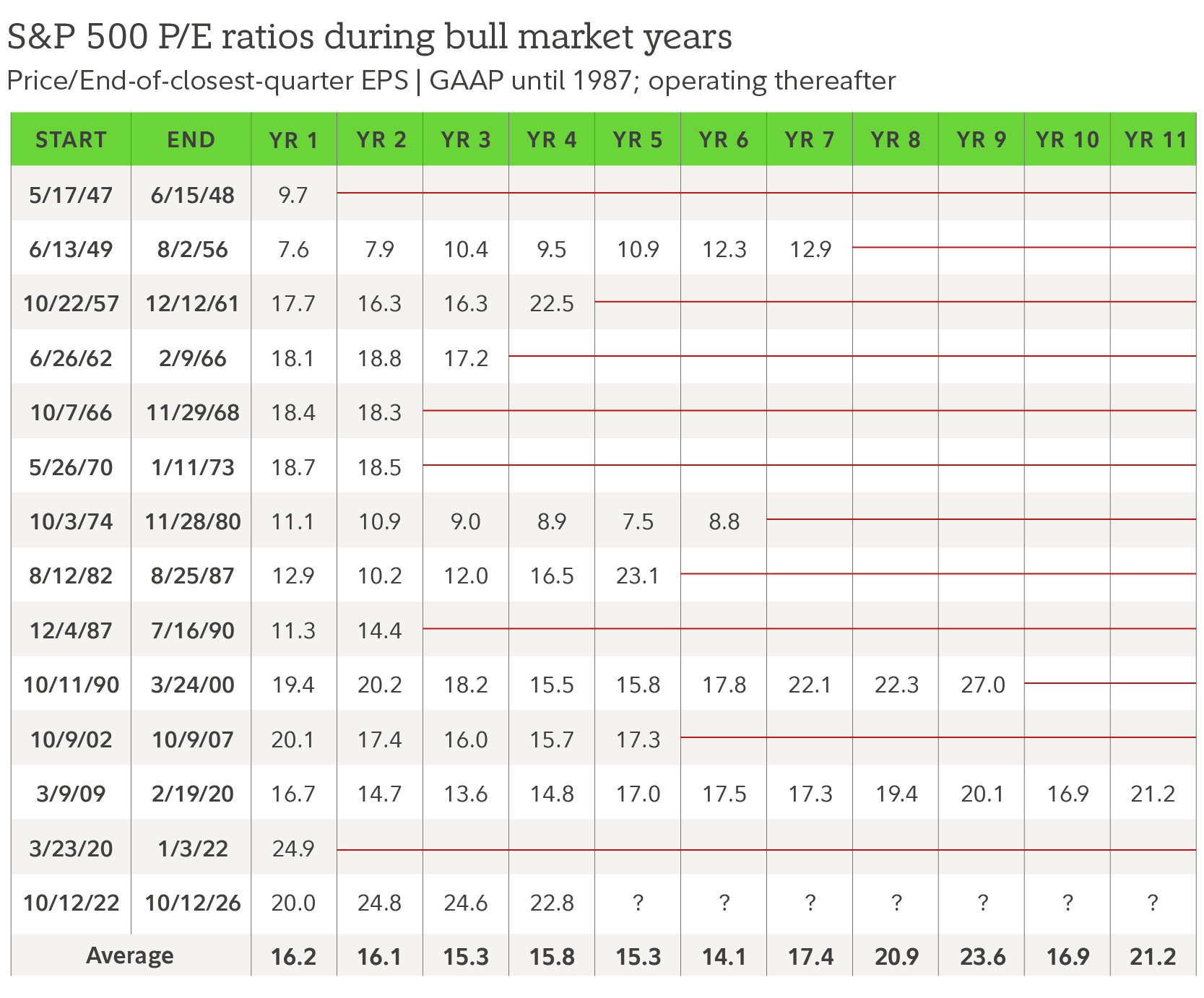
Recent market commentary has placed the S&P 500’s P/E ratio around 22.8 under one valuation measure, substantially above the approximately 15.8 average cited for the fourth years of previous bull markets.
Valuation estimates can differ depending on whether they use historical or projected earnings. For example, FactSet’s October 30 report placed the S&P 500’s forward 12-month P/E ratio at 18.7, below its five-year and ten-year averages.
These differences underscore an important point: the broader market is not uniformly expensive, but some sectors and individual stocks carry unusually high expectations.
When valuations are elevated, companies have less room for disappointing financial results.
A business that reports slower-than-expected revenue growth or weaker profit margins can see its share price decline sharply, even if it remains fundamentally profitable.
This is particularly relevant for technology companies and other high-growth businesses whose stock prices already reflect years of anticipated earnings expansion.
Fidelity’s Asset Allocation Research Team has warned that elevated valuations, especially among AI-related stocks in the United States and emerging markets, provide limited protection against medium-term economic, political, and geopolitical risks.
Why high valuations do not necessarily signal a crash
Expensive stocks are not automatically bad investments.
Some businesses deserve premium valuations because they possess strong competitive advantages, consistent earnings growth, pricing power, and exceptional financial performance.
Investors may reasonably pay more for companies expected to generate substantial future profits.
Recent corporate earnings have provided considerable support for that argument.
According to FactSet’s October 30 earnings update, approximately 82% of S&P 500 companies reporting third-quarter results had exceeded analysts’ earnings expectations. The index’s blended year-over-year earnings growth rate stood at approximately 30.2%.
Those figures suggest that earnings growth, rather than speculation alone, continues to support important parts of the stock market.
If corporate profits keep expanding, current valuations may become easier to justify.
Still, investors should distinguish between a great company and a great investment. Even an outstanding business can produce disappointing stock returns when purchased at an excessively high price.
3. An Artificial Intelligence Bubble and Growing Concentration Risk
Artificial intelligence has dominated stock market headlines throughout 2026, just as it did in previous years.
The AI boom has helped drive extraordinary demand for advanced semiconductors, cloud computing, data centers, networking equipment, and other technology infrastructure.
Leading AI developers, semiconductor manufacturers, and hyperscale cloud providers have become some of the most influential businesses in the global economy.
The scale of AI-related investment is enormous.
Some economic estimates have attributed roughly 40% of recent U.S. GDP growth to AI-related activity, although methodologies differ considerably. A September analysis by J.P. Morgan Asset Management estimated that AI-related investment contributed approximately one-fifth of U.S. real GDP growth over the preceding year after adjusting for imported hardware.
Regardless of the precise contribution, AI has clearly become a significant driver of capital spending and investor enthusiasm.
However, its extraordinary success has also created several concerns.
The danger of an AI investment bubble
The first risk is valuation.
Investors have assigned substantial premiums to companies expected to benefit from artificial intelligence. In some cases, stock prices reflect assumptions that revenue and profits will continue expanding rapidly for many years.
If adoption slows or companies fail to generate adequate returns on AI investment, those expectations could prove too optimistic.
The second concern is concentration.
Major AI-related companies represent a significant share of the market capitalization of leading U.S. stock indexes. Investors holding multiple technology stocks, growth funds, and broad-market ETFs may therefore have more exposure to the same AI businesses than they realize.
When a small group of companies drives a substantial portion of market gains, disappointing results from just a few industry leaders can affect the broader market.
Recent volatility in AI-related stocks illustrates how quickly investor sentiment can change.
A third concern involves the rising cost of building AI infrastructure.
Advanced computing systems require enormous investments in chips, data centers, electrical equipment, cooling technology, and power generation.
Higher interest rates increase financing costs, while electricity shortages and delays in connecting new data centers to the power grid can prevent companies from fully utilizing the equipment they have purchased.
These infrastructure challenges raise questions about how quickly AI investments can translate into sustainable profits.
Why the AI growth story remains compelling
Despite these concerns, the AI boom is supported by genuine business activity.
Many leading technology companies continue reporting strong earnings, expanding customer demand, and significant opportunities to commercialize AI products.
Artificial intelligence is also moving beyond software applications into industrial operations, logistics, healthcare, financial services, and scientific research.
Furthermore, the investment opportunity extends well beyond the most recognizable AI companies.
Businesses supplying electrical infrastructure, industrial equipment, networking technology, and energy resources may benefit from continued data-center expansion.
Industrial metals, particularly copper, are attracting attention because AI infrastructure requires substantial electrical and power-distribution capacity.
For investors, the central lesson is diversification.
Rather than placing too much capital into a handful of AI-related stocks, a broader mix of businesses and industries can reduce dependence on any single technological trend.
AI may continue transforming the economy for decades, but that does not mean every AI-related stock will deliver attractive returns.
4. Global Geopolitical Instability and Political Uncertainty
Geopolitical uncertainty remains another major threat to financial markets.
The ongoing war in Ukraine, conflicts in the Middle East, and recent protests and civil unrest in France have created a challenging international environment.
At the same time, the United States is approaching its November midterm elections, introducing uncertainty surrounding future fiscal policies, government spending, regulation, and international trade.
Political events do not always have lasting effects on stock prices, but they can influence investor confidence and business decisions in the short term.
How global conflicts affect financial markets
The most immediate concern is the potential disruption of international supply chains.
Armed conflicts and political instability can interfere with transportation routes, energy supplies, manufacturing operations, and cross-border trade.
When companies face higher transportation or production costs, their profit margins can come under pressure.
Energy prices are especially sensitive to geopolitical developments.
Oil and diesel prices have remained elevated during much of 2026, with U.S. diesel prices climbing to historically high levels.
Higher fuel expenses affect far more than transportation companies.
Farmers, manufacturers, retailers, airlines, and logistics businesses all depend on reasonably priced energy. When transportation costs increase, businesses frequently pass part of those expenses on to consumers.
That can intensify inflation and potentially encourage central banks to maintain higher interest rates.
In other words, geopolitical instability can reinforce several of the other stock market risks investors already face.
Political uncertainty can also discourage long-term business investment, particularly when companies are unsure about future tariffs, regulations, or government policies.
Why global instability may not derail the bull market
Despite the risks, the global economy has demonstrated considerable adaptability.
Businesses have spent years adjusting supply chains, diversifying suppliers, improving operational efficiency, and developing alternative ways to manage international disruptions.
Many economies have continued expanding even while dealing with elevated energy costs and geopolitical tensions.
There is also hope that diplomatic negotiations and peaceful resolutions could eventually reduce some of today’s conflicts.
Lower geopolitical tensions could help stabilize energy markets, improve global trade conditions, and ease inflationary pressure.
Even without immediate resolutions, businesses and financial markets may continue adapting to uncertainty, as they have repeatedly done in recent years.
Investors should therefore remain attentive to geopolitical developments without assuming that every international crisis will trigger a prolonged bear market.
5. Weakening Consumer Confidence and Rising Household Debt
Consumer confidence is one of the most important indicators of economic health.
When households feel secure about their jobs, finances, and future income, they are generally more willing to spend money. When confidence deteriorates, consumers often postpone major purchases, increase savings, or reduce discretionary expenses.
That matters enormously for the United States, where consumer spending accounts for roughly two-thirds of economic activity.
Unfortunately, consumer sentiment has been under pressure throughout much of 2026.
Signs of weakening consumer confidence
In France, nationwide protests, political tensions, and rising living costs have contributed to a sharp deterioration in household confidence.
According to France’s national statistics agency, INSEE, the country’s consumer confidence index fell to 80 in October, its lowest reading since June 2013.
American consumers have also become increasingly concerned about inflation, household finances, and the broader economic outlook.
The University of Michigan’s Consumer Sentiment Index fell to 48.1 in September, reaching its lowest level in four months and approaching historically depressed territory.
October brought some relief.
The Conference Board reported that its Consumer Confidence Index increased to 91.7 from 84.2 in September, reflecting improvements in consumers’ assessments of current economic conditions and expectations.
Nevertheless, the broader weakness in confidence remains a concern.
Household debt presents another potential vulnerability.
According to the Federal Reserve Bank of New York, outstanding U.S. credit card balances reached approximately $1.26 trillion at the end of the second quarter of 2026.
Higher credit card debt can become particularly burdensome when interest rates remain elevated.
Consumers carrying large balances may devote more income to interest payments, leaving less money available for discretionary spending.
If financial pressure intensifies, retailers, restaurants, travel companies, and other consumer-facing businesses could experience slower sales growth.
Why consumer spending remains a bright spot
The encouraging news is that weak confidence has not translated into an equally dramatic decline in actual consumer spending.
Despite higher living costs and growing concerns about the economy, American households have continued purchasing goods and services.
That resilience has helped support corporate earnings and overall economic growth.
There is also a possibility that several of today’s economic pressures could ease together.
If geopolitical conflicts move toward peaceful resolutions, energy costs could decline. Lower energy prices could help reduce inflation, potentially limiting the need for additional Federal Reserve rate increases.
More stable prices and borrowing costs could improve household purchasing power and financial confidence.
Such developments would be particularly helpful as the holiday shopping season approaches, traditionally an important period for retailers and consumer spending.
Improving consumer sentiment could provide another source of support for the stock market heading into 2027.
What Should Investors Do About These Stock Market Risks?
The five risks facing the stock market are closely connected.
Geopolitical conflicts can increase energy prices. Higher energy costs can fuel inflation. Persistent inflation can prompt the Federal Reserve to raise interest rates. Higher interest rates can pressure stock valuations and corporate profits, while weakening consumer confidence can reduce spending and economic growth.
This interconnectedness means that a deterioration in one area can affect several others.
It also means that improvement in one area could help ease pressure across the broader economy.
For investors, the most important response is not necessarily to predict every market movement, but to build a portfolio capable of handling different outcomes.
Diversification remains essential. Holding investments across industries, asset classes, and geographic markets can help reduce exposure to a single economic development or investment theme.
Investors should also review portfolio concentration, particularly if they own substantial positions in technology companies or AI-related investments.
A portfolio that appears diversified on paper may still depend heavily on the performance of a small number of companies.
Equally important is aligning investments with personal financial goals, time horizons, and risk tolerance.
Long-term investors may be able to withstand periods of volatility while maintaining exposure to businesses with strong fundamentals. Investors with shorter time horizons may need to place greater emphasis on capital preservation, liquidity, and stable income.
Regular portfolio reviews and periodic rebalancing can help keep investment allocations consistent with an established strategy.
Investors should also avoid making emotional decisions based solely on short-term market fluctuations.
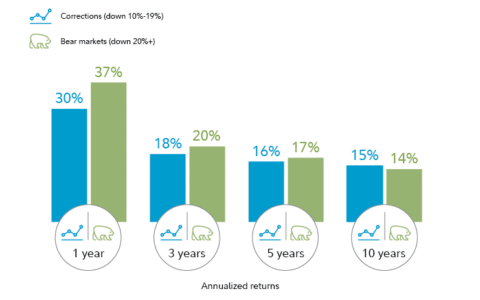
Market corrections are a normal part of investing, even during powerful bull markets. Selling indiscriminately during a temporary downturn can prevent investors from participating in a subsequent recovery.
On the other hand, ignoring risks because stocks have performed well can leave portfolios vulnerable to unexpected losses.
The objective is to maintain a disciplined investment approach rather than attempt to time every market peak or bottom.
Final Thoughts: Reasons for Caution, but Also Reasons for Optimism
The U.S. stock market has delivered another impressive performance in 2026, continuing a bull market that began four years ago.
Nevertheless, persistent inflation, higher interest rates, elevated valuations, concerns about an AI bubble, geopolitical instability, and weakening consumer confidence present meaningful challenges.
Any of these developments could contribute to additional volatility or a market correction.
Yet the outlook is far from uniformly negative.
Corporate earnings remain strong, consumer spending has proven resilient, and businesses continue investing in artificial intelligence, infrastructure, and other sources of future growth.
Many of the risks weighing on investor sentiment also have plausible paths toward improvement.
Inflation could stabilize, interest rates could stop rising, geopolitical tensions could ease, and consumer confidence could recover.
If those developments occur while corporate profits continue growing, the bull market may have additional room to run.
The most important lesson for investors is that a strong market does not eliminate risk, just as an uncertain market does not eliminate opportunity.
History has repeatedly demonstrated that stock prices can change direction quickly, sometimes with little warning.
Rather than becoming overly optimistic after substantial gains or excessively pessimistic during periods of volatility, investors should focus on diversification, financial fundamentals, and long-term objectives.
Those who understand the risks, maintain appropriate portfolio allocations, and prepare for unexpected market swings are generally better positioned to navigate uncertainty.
As 2026 draws to a close, caution and optimism do not have to be competing investment philosophies. A well-balanced approach can accommodate both.
Disclaimer: This article is intended for educational and informational purposes only and should not be considered personalized financial or investment advice. Investing in stocks, bonds, ETFs, and other financial instruments involves risk, including the potential loss of principal. Investors should evaluate their own circumstances and consult a qualified financial advisor before making investment decisions.
Author:Com21.com,This article is an original creation by Com21.com. If you wish to repost or share, please include an attribution to the source and provide a link to the original article.Post Link:https://www.com21.com/5-biggest-stock-market-risks-in-2026-what-investors-should-watch-before-year-end.html